Houston's Lessons Relevant to Asia's Coastal Cities
Published by Water Network Research, Official research team of The Water Network in Academic
The lessons from a disaster in Houston are relevant to densely populated coastal cities in Asia, experts say.
As in Mumbai, Bangkok and half a dozen other coastal Asian cities, rapid growth of concrete urban infrastructure and conversion of wetlands that act as natural drainage have made Houston more vulnerable to flooding.
Also mirroring the explosive growth of coastal Asian cities, Houston has grown faster than most other cities in the US, and is today America's fourth-largest.
"We are adding about 100,000 people a year," Professor Sam Brody of Texas A&M University in Galveston told NBC News. "With those people come parking lots, pavement, rooftops, roadways - and that makes it very difficult for the water to drain."
Mr Greg Norman, a spokesman for Houston's Public Works Department, said in a phone interview with The Sunday Times: "That does have an impact on drainage, because it covers land that would normally be available to absorb storm water."
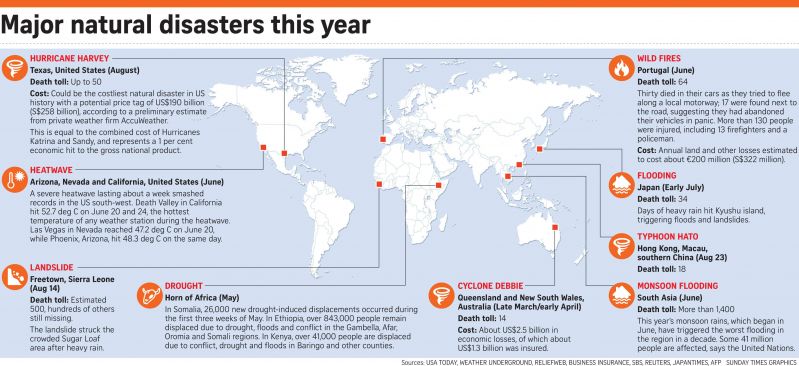
The same applies to Mumbai, which is suffering annual floods made worse by the constriction of natural drainage and conversion of natural green areas. "Mumbai cements open spaces, fills wetlands, hacks trees, chokes drains, over-constructs. Result? Traumatic flooding," said editor and environmental activist Bittu Sahgal.
Mumbai suffered a devastating flood in 2005 that killed more than 1,000 people. Since then, if anything, the situation is worse, Mr Sahgal told The Sunday Times.
And like other overbuilt coastal cities - Bangkok, for instance, where in 2011 flood water stood for days without draining - Houston has also been sinking because of the withdrawal of water from aquifers to sustain its population.
"This city is all about commerce, growth and money, and more commerce and growth and money," Ms Wolf, 47, a resident of Houston since 2011, said over the phone.
Coastal cities increasingly face extreme storm and rainfall events, at least in part due to global warming.
Houston has since 2011 tried to switch from drawing underground water to surface water, and use innovative financial mechanisms to pay for drainage.
Hurricane Harvey, though, simply overwhelmed those efforts.
"I have my sympathies, you can't design for that amount of rain," Mr Ani Dasgupta, the Washington- based global director of the World Resources Institute's Ross Centre for Sustainable Cities, told The Sunday Times. But that does not invalidate the lessons.
"There are two things cities can do: Build infrastructure that is resilient to climate and weather events, that might cost 5 or 10 per cent more - which is pretty small compared to the risk; and use green infrastructure like water bodies and spillways to manage weather events," Mr Dasgupta said in a phone interview.
"A lot more focus on risk management needs to be taken at the municipal level," Prof Rappaport told The Sunday Times. "A lot of threats related to water and storm damage can be managed with some very thoughtful planning ahead of time. That's the fundamental responsibility of government, to protect its citizens."
Source: Stratis Times
Tags
Category: Academic
- Infrastructure
- Integrated Infrastructure
- Urban Water Infrastructure
- Infrastructure Management
- Flood management
- Flood Risk Management